This Is Real Democracy Baby
I went to my first election count at Ipswich Town Hall. I came out with a headache, pages full of strange observations, and a complicated feeling about the whole thing.
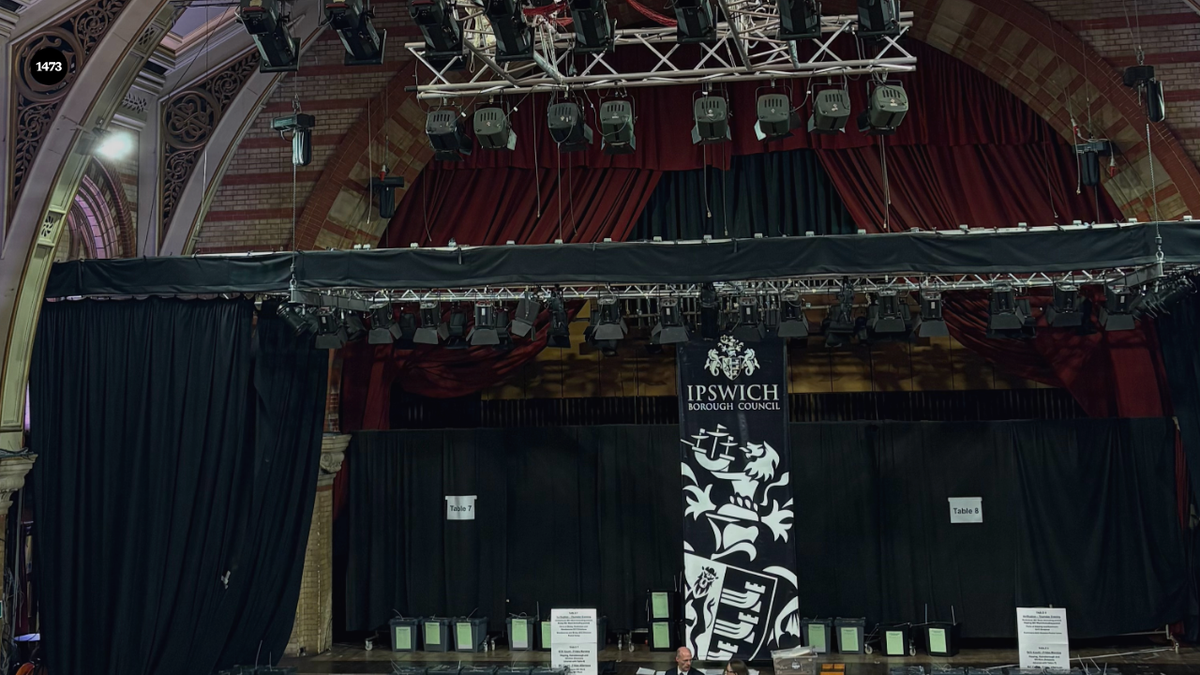
There are cards on the tables, colour coded. Purple, yellow, red, green, blue — each one carrying the weight of a different party, a different version of what Ipswich could look like.
I am 22 years old and this is my first election count. I have a laptop, a phone, and a vague plan to document my thoughts and feelings from inside Ipswich Town Hall — which is the kind of idea that sounds extremely good at 9 a.m. and slightly less good when you're sitting in a large room watching people count pieces of paper in near silence. A riveting way to spend the day, I must say.
But here's the interesting thing: the atmosphere is genuinely electric. In a hold-your-breath way. Whether done on purpose or not.
General overview
It is the 8th of May 2026. I usually look at the Town Hall as a quiet yet dominating building on the Cornhill. Today it felt like walking right into the lions mouth.
We were led to a balcony inside the building. I will admit that I had originally thought the elections were going to take place outside and that the balcony was the one on the outside of the Town Hall. Don't ask.
The main hall was a glorified theatre hall, though at times it reminded me of a school assembly hall. I kept half-expecting a projector to come down and for everyone to start singing in unison.
The room hit me immediately — stuffy, despite being massive. A huge banner reading IPSWICH BOROUGH COUNCIL hung at the front like a declaration. Below it, boxes. One from each ward, stacked and labelled, waiting. A vote I had placed twenty-four hours ago was somewhere in there. The future, apparently, was in those boxes. I tried not to think about that too hard.
There were three other journalists among us. I have to point this out, because my conscience wouldn't allow otherwise — all three were men. One from the Ipswich Star, a BBC-adjacent reporter, and a Suffolk Sounds gentleman. I was the only young woman there. This tends to be the case in a lot of the rooms I find myself entering lately.
Fashion in politics
I think we have no hot people in politics.
Hotness is subjective, of course — especially to a 22-year-old with questionable taste. But what I actually mean is something I've been thinking about for a while.
The generations before mine tended to lose their personality when it came to their professional lives. There is always a time and place for a joke, sure. But so many people suppressed their real selves in the name of being taken seriously that they made genuinely interesting topics seem boring. Personality makes things accessible. And we all have it, although, that's also subjective.
Reform came in suits. Very proper, very elegant.
The Lib Dems came in with grey hair and the quiet confidence of people who have been coming to these things for thirty years and will be here thirty years from now. There's a yellow tint to them somehow. An aura. It might be the rosettes. It might be something else. Someone was definitely wearing yellow shoes.
Colin Smart arrived in a t-shirt. He immediately gained my full respect. There is something striking about a t-shirt that juxtaposes a room full of suits.
Tony Gould and another grey-haired man — I never caught his name — were very much in cahoots. Walking around with the energy of two people who have been quietly running things for longer than anyone in the room has been paying attention. Whatever they were saying to each other, I suspect it was either very important or very funny. Possibly both.
And then there was Jack Abbott. Default outfit, bags under his eyes — metaphorically and physically. The kind you get from caring about something and watching it change right in front of you. I find this oddly reassuring.
The alternative is politicians who look rested, and I'm not sure I trust that. Anyone who looks supremely confident in this world sends a small shiver down my spine.
I notice that the parties have, I assume without any apparent coordination, segregated themselves into one area each. Solidarity expressed through seating arrangements.
Biscuits
This was the moment my editor decided to grab some biscuits from the snacks area. The biscuits were dry — though that's probably not the organisers' fault. More likely mine for dehydrating myself all day. No rest for the wicked.
The votes were coming in slowly. Reform, reform, reform — the name kept appearing, kept landing in the room with a particular weight. The suits made more sense now.
There is something happening in British politics that is bigger than any one count in any one town hall, and you can feel the edge of it in here, in the way certain people are watching certain tables a little too carefully.
As a young person thrown into this world, I used to wonder about the point of all this. Why is the very thing that accounts for our unity able to divide us so deeply? Then I started reading each party's policies and realised that everyone is trying to write a different story in the same book.
In a way, politics is just one book in the library of the UK. Every citizen has their own book too. But the average citizen cannot touch any other book — and the one titled Politics sits on a different shelf depending on whether you live in Ipswich, Manchester, or London. You don't get to touch that book. But you have to abide by its rules. Whatever that means.
I should also tell you that the Official Monster Raving Loony Party appeared on one of the ballots. Democracy is a broad church.
The Maze
Nobody warned me that the inside of the Town Hall was a real maze. Well — the woman who showed us around did say I might get lost. I didn't believe her. This was a mistake.
Around halfway through I realised the spectacle came with self-appointed breaks. The nicotine also began calling (pick your vices.) I left through one side of the building and had to re-enter through the other. Simple enough, I thought. Of course I can manage this.
The thing about the Town Hall is that the instinct is to go up. So I went up. Past the first floor, past several candidates who I stopped to ask for directions, who all gestured vaguely upward with the confidence of people who also had no idea. I kept going. Top floor. Toilets. More toilets. The Mayor's chambers. I peered through the window. White cloths over everything, the room under construction or storage or some kind of hibernation.
There was also a lift up here that I had not been told about. I stared at it for a moment. Then I took the stairs back down.
I passed a councillor in the stairwell who looked completely depleted. Like someone had taken something out of them and hadn't put it back yet. We nodded at each other. I kept moving.
I also passed Morgan Brobyn — now Reform councillor for Stoke Park — talking quietly on the phone in a corridor. He looked up and smiled.
Eventually I found the woman who had brought us here in the first place. She looked unsurprised to see me. She led me back — down the stairs, through the back corridors, past a room with bins and a door that required a key card. I noted this. I should not have forgotten this.
On the way I passed other rooms — high ceilings. Councillors sitting, standing, leaning against walls with their blue folders.
Every elected councillor was given a blue folder. I still wonder what was inside.
"Welcome to your first day as councillor. Firstly — wow, you should be so proud. Not many get to this point. Take a deep breath. The fun begins now."
The Results
The results were released one by one, ward by ward. A woman stood at the front with a microphone and delivered the same script each time, swapping out the interchangeable details. Name. Party. Votes. Next. There was something almost ritualistic about it — the repetition, the way everyone held themselves slightly differently depending on which name was coming.
At one point a group of Labour candidates stood together as results came in. They just stood there, mouths covered, watching. It was genuinely heartbreaking — not in a political way, in a human way. These were people who had spent months integrating themselves into their communities, knocking on doors, learning names, showing up. And now they were standing in a room watching it not be enough.
The juxtaposition was stark. On one side of the room, people patting each other on the back. On the other, silence. Hands over mouths. The same moment, experienced completely differently depending on where you were standing.
I got talking briefly to a Reform member near the edge of the room. Younger than I expected — around my age. I asked whether he was interested in politics. He said no, that he'd never studied it, that he'd been thrown in the deep end. Respect — though probably not my best conversation opener.
The cards turned out to be majority light blue.
Thoughts, feelings, opinions
By the time I leave I have a headache. The kind that builds quietly over a few hours in a large room under fluorescent lights with too much going on to properly process.
The count wound down. People began tidying up — folding tables, stacking boxes, dismantling the whole careful architecture of the day. Me and my editor decided it was time to leave. I led the way. This was a bad idea.
We ended up in the bin room.
The same bin room I had passed on my way back from being lost — the one with the key card access I had noted and then completely forgotten about. Both doors were key card restricted. We stood there for a moment, in a room full of bins, at the end of an election count, having just watched democracy happen in real time, unable to get out. There was an emergency exit. We took it. We left through the side of the building, out into the Ipswich streets.
I forgot that it was still light outside.
I'm also aware of something else — a feeling I've been trying to name since I walked in. A weird vibe, a weird energy. It's the gap between what this is supposed to be and what it sometimes is. The count is for the people. The outcome is always for the people.
But sometimes you sit in a room and you wonder how much of that is truly true. How much of real democracy is actual real democracy. Of course you cannot please everyone — we would lose the point of life if that were the case. The good always comes with the bad, and both of those are subjective. And I think that wondering — that feeling of uncertainty — is probably the most important thing I took out of there.
That, and the knowledge that both doors in the bin room were key card restricted. Information I will be carrying with me for some time.
This piece is a first-hand account of the Ipswich local election count, 2026. Names of candidates and councillors are used as observed on the day. Views and observations are the writer's own. This is gonzo journalism — it is not a normal account. It was never supposed to be.