The World of AI Within Universities
An Interview with Professor Nicholas Caldwell about AI at the University of Suffolk

AI is the main buzzword we hear being talked about on our phones, computers and various other gadgets that we have in our home.
It’s a revolution that has been growing for a while and it is intertwining with every aspect of our lives. For example, when applying for jobs, - where they don’t want to use AI but prefer that you have the knowledge of how to use specific tools.
Yet with new tools, people have criticism towards how they are used and who uses them. For example, would people be using it to help others draft emails to sound more professional or they use it to help them with a work task and make it go a bit faster?
There is a rise of people using the tool to help them plan what to buy or research a topic they are interested in. Now, it can be immensely helpful and useful for people, especially when completing a task that may involve summarising a piece of text and providing notes for them to use.
AI usage stats
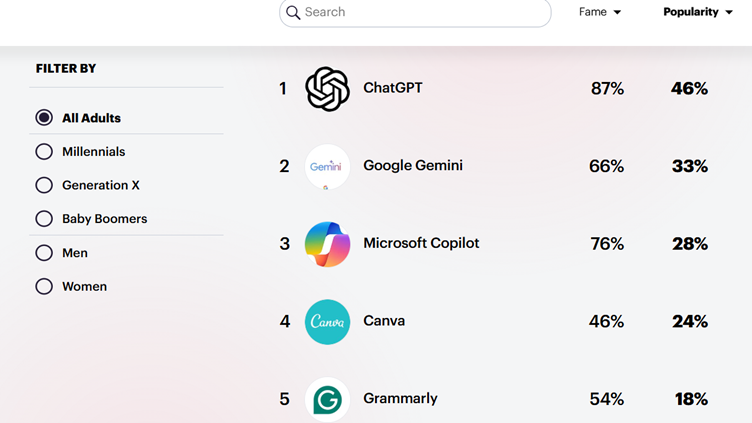
According to a recent YouGov poll, ChatGPT has a 46% popularity among all adults, followed by Google Gemini at 33% and Microsoft Copilot at 28%. This shows that those who use the tools prefer ChatGPT as their main AI chatbot to help them discuss their life or help them sound more professional.
We also see people within universities using the software to help them with assignments or put into easier words what they must do for the work needed.
This is why I wanted to speak with Professor Nicholas Caldwell at the University of Suffolk, who is the director of the Digital Futures Institute and professor of information systems engineering. He has been involved with undergraduate teaching for more than two decades.
In conversation with Professor Nicholas Caldwell
“I am of a vintage where, in my early teens 81s (ZX81), BBC Bs turned up. I started programming with those, and that became my life route. I'm gonna keep doing this. It became a degree and a PhD.”
The ZX81 is a low-cost home computer that launched in 1981. The BBC Micro model B computer was part of the BBC's computer literacy project. It helped increase computer literacy and helped encourage a wide range of projects. It sold over 1.5 million units and was widely used in schools
I wanted to know if the university had a policy around using AI, since, depending on what kind of assignment you are working on, it’s better to know what and how the policy works.
“So, we've got several policies now, depending on who you happen to be. If you're a student, there is a policy that indicates that certain uses of AI will get you into deep trouble, particularly if it's for a module assignment and you've been explicitly told.
“For the University of Suffolk, that means it's Copilot. We've paid cash for some enhanced licences. You may use AI, you must disclose it, you must tell us what you've used. And it might even be, there's some stuff that AI has generated.
“This means it’s stored locally within the university, rather than any outside influence on where the data goes. That would be for students, so you can use it to help you but you would have to disclose it.”
Using AI in class
This led into a discussion on what can happen with students who either use AI or disclose they have used it, along with those who don’t. Since for some they would know how to use these tools to make them appear smarter with assignments.
“Well, in the sensible route that most universities are prepared to do is bring people to a viva.”
“You bring them to an oral examination. You get people to actually explain what it is. And, you know, we've had instances where, students have been brought to Viva, and they clearly have no clue. And it ends badly for them.
“If it's a module assignment that involves the generation of text, and you know that this can be done by AI. You can't, there's no alternative that would be more difficult.
“Whereas if you've done the work, you understand it. You can answer a question. Some students will be nervous. We understand that. And we can tell when students are nervous most of the time.”
Students have a chance to explain the material and show their understanding. Yet if you don’t understand the material, it could lead to a mark on your file.

AI Bubble
I then asked about the term AI bubble because it gets used a lot when being discussed in the news, along with getting its own definition. Many founders who created it talk about it and the effect it is having on the world.
“So, in the past we've had periods where a technology comes along, everybody jumps on it, thinks it's brilliant, it gets investment, it motors along for a bit, and then we discover it doesn't quite deliver the promises.
“And so, we've had AI winters in the past. The most recent one, of course, that we're in now, we've had new theories to do stuff. We've got a lot more computational power, so we can actually process stuff. We've got lots more data.
“Originally, it was all legitimate data. Now, of course, some people can get in data they shouldn't have done, but that’s meant that things that failed the last time round now work. And of course, people pile in on this.”
In relation to that, Nicholas then talked about the AI bubble and how his peers felt about the various chatbots and tools they see potential in, and those that are for more complex tasks
“Now some of my colleagues and I talk in terms of worthy AI, and essentially, they're thinking that some AI is not worthy. On the worthy AI, you think not typically in terms of generative AI (images, text, video, and computer code), but things like classification AI (sorting data points).”
Classification AI is where the model sorts data points into groups called classes, then from that it can learn to put unseen data into the correct place. Some models learn from what you have input and develop a pattern. Whereas classification is a model that leans hard on the training data, which can become unable to make accurate predictions in the world.
Evolution of chatbots
I wanted to enquire about chatbots that have evolved, and with recent comments from the Pope, are we turning towards a paradise machine where we are losing the human touch? Because it feels like we are drifting away from it all. Especially with art, writing and doing research about something and spending a long time on it.
“We've seen that happen in terms of people becoming addicted to social media. And their online friends are more real to them than their actual friends. We've seen people become addicted to incredibly long conversations with incredibly helpful chatbots.
“We've seen people been led astray by these chatbots because of all the reinforcing, - I'll do things that make you seem “happier”. In the same way that a social media algorithm can take you to a dark place, a chatbot can take you in a conversation to a place you don't want to go. Or convince you that you're the next thing since Einstein.
“So, there is certainly that danger and there are the dangers of could it do us harm? At the moment, it's harm probably by bad actors or by failure to put the guidelines on. Failure to tell it what not to do.”
I wanted to see if he had experienced an uptick in people using these tools within the university and those around him. Since the university has a contract with Copilot, have more students or staff been using it. As well as other AI chatbots.
“Yep.”
“We have staff and students who've been using all of the above. Copilot was almost a late entrant. So, before we had Copilot licences, people were experimenting. We now encourage people to use the one we paid for because we know where the data is living.
“But yes, we have people use everything fundamentally. Lots of my colleagues will speak quite highly of different tools for slightly different jobs.
“And at this point, I stopped worrying about which one will be stronger because the next model: everything may change again.”
I do agree that trying to keep up with what new features one has compared to others can drain energy. Yet I would track what’s going on with any current updates because it can feel overwhelming with the amount of new updates and information needed for these tools.
Professor Nicholas Caldwell's journey
For the final question, I wanted to know if there was a person or story that resonated with him to choose the current path?
“When I was at university for my final-year dissertation, I wanted to do something that was far too difficult. I sent my supervisor at the time, identifying nouns in a passage down to the old questions that used to be asked in English literature about Oliver Twist.”
“How does Charles Dickens show man's inhumanity in Oliver Twist? At the time, it was really quite hard just to identify the nouns, let alone what Charles Dickens' saying about nasty things being done to humans?
“But that got me into AI there.
“I was fortunate in that a friend knew of me, knew that I was interested in AI of that era. And he worked for a company that was looking for an expert system, as we called it in that era, to be built. And he passed my name on to the people at the engineering department in Cambridge.
“And that became my PhD. And from there, I continued to do stuff in software, not necessarily always in AI, because as a contract researcher, you have to go where the money is. And that didn't always mean it was AI.
“But that sort of route got me then into the next stage of my career, the academic stage as opposed to possibly being somewhat good with computers, to doing research into the thing.
“But that was a friend knowing of me. So that wasn't the case of who I knew, it was who knew of me.”
AI isn’t going anywhere for a while since those who created the tools want it to essentially be second nature to our lives. Yet how far will it continue to grow and develop? Will we have powerful technology or laws to make sure it has barriers which can help people feel a whole lot safer?
The rate at which it will continue to grow is something we can only imagine for now. We should be keeping an eye on what new features are announced by the tech companies. Since it’s better to know what to expect rather than being in the dark about what will happen. The more it develops, the less control we may have over how companies operate the technology. Along with laws needed to be updated in line with how people can use these tools for daily work life but also for those that would take it several steps further.
People will continue to use it in their daily workflow and lives to help them with a task or solve a problem. As well as students when answering a question for an assignment or helping them draft an email. Yet it’s better to understand these tools than just read about them, since you can test them out to see what they offer.
However, with that you have to be aware of the environmental factors as well, since the amount of resources and power needed for the various chatbots are and will continue to cause damage.